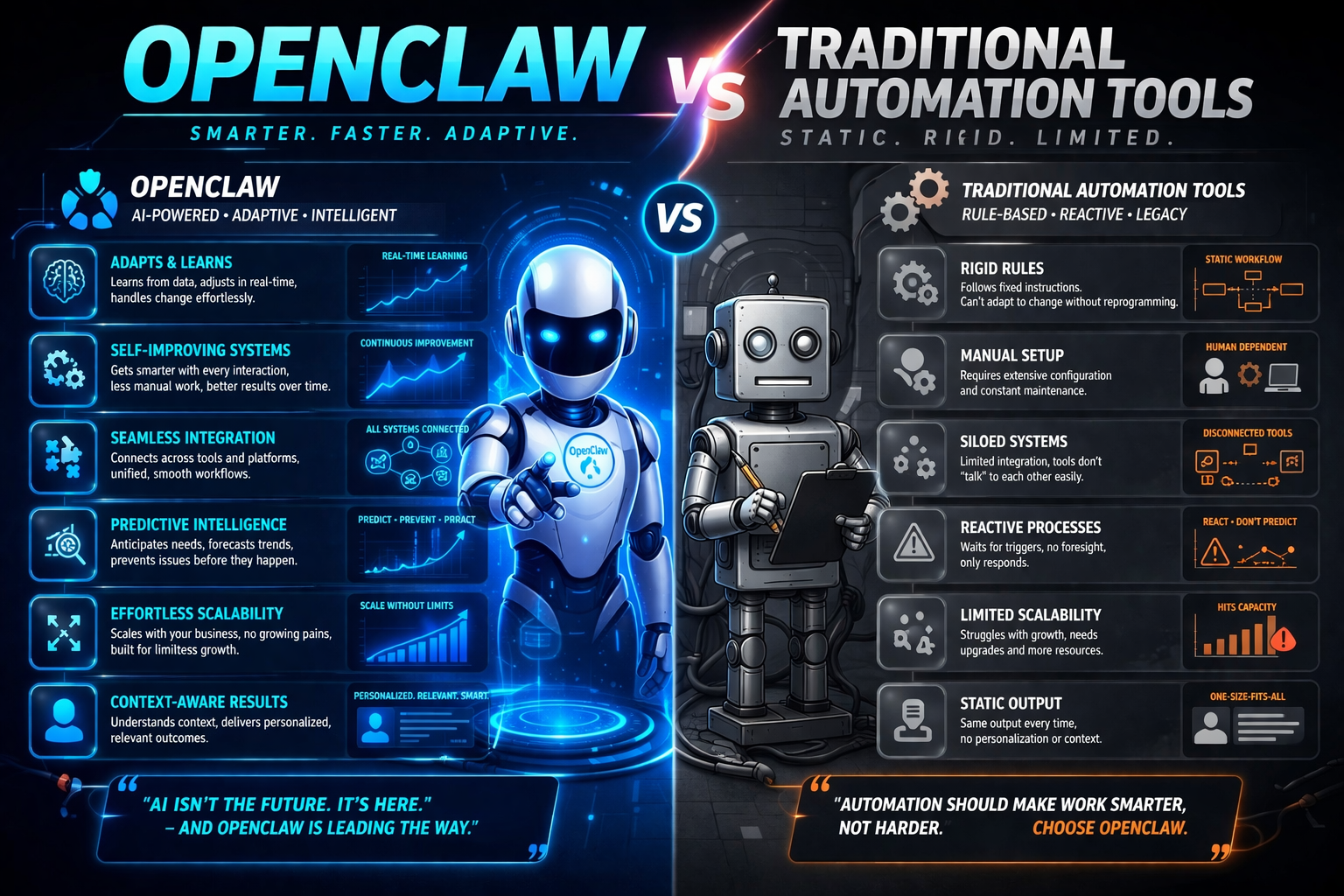
Most automation tools promise efficiency—but here’s the truth: some just help you move faster in the wrong direction. When you compare OpenClaw to traditional automation systems, it’s like comparing a self-driving car to cruise control. One simply follows instructions… the other actually thinks.
Introduction
Imagine running a business with a map that never updates. That’s what traditional automation feels like—fixed routes, no flexibility. Now picture a GPS that reroutes in real time, predicts traffic, and learns your habits. That’s OpenClaw in action.
In this article, you’ll discover how OpenClaw stands apart from legacy automation tools and why its AI-driven capabilities are reshaping the way modern businesses operate.
The Shift from Static Rules to Living Intelligence
Traditional automation tools are built on rigid frameworks. They follow predefined rules, executing tasks exactly as programmed—no more, no less. While this works for predictable processes, it quickly falls apart when conditions change. A slight variation in input can break the entire workflow, forcing teams to step in and manually fix the issue.
OpenClaw approaches automation differently. Instead of relying solely on static instructions, it uses AI to interpret context and adapt in real time. It learns from patterns, adjusts to new data, and continuously refines its outputs. This shift from rule-based execution to intelligent adaptation is what gives OpenClaw its edge.
Research from Gartner suggests that AI-driven automation can significantly boost operational efficiency, and it’s easy to see why. As Andrew Ng put it, “AI is the new electricity.” It doesn’t just power processes—it transforms them.
Practical Tip: Start by applying OpenClaw to processes that frequently change or require human judgment—this is where its adaptability shines.
From Manual Configuration to Self-Improving Systems
Setting up traditional automation often feels like building something fragile. It requires detailed configuration, constant monitoring, and frequent updates to keep things running smoothly. The system doesn’t improve unless someone actively tweaks it.
OpenClaw, on the other hand, evolves. It learns from usage, identifies inefficiencies, and optimizes workflows over time without constant human intervention. This self-improving nature reduces the burden on teams and allows systems to become more effective the longer they’re used.
A McKinsey study highlights that AI can dramatically reduce the time required for process optimization. That means what once took months of manual adjustments can now happen automatically in the background.
As Elon Musk once said, “The pace of progress in AI is incredibly fast.” OpenClaw embodies that speed by turning automation into a living system rather than a static tool.
Practical Tip: Let OpenClaw run continuously and review its performance insights periodically instead of micromanaging every detail.
Breaking Down Silos with Seamless Integration
One of the biggest frustrations with traditional automation tools is their inability to communicate effectively with other systems. They often operate in isolation, requiring manual intervention to bridge gaps between platforms.
OpenClaw eliminates these silos by integrating seamlessly across tools and workflows. It acts as a central intelligence layer, connecting systems and enabling them to work together harmoniously. This unified approach not only saves time but also reduces errors caused by fragmented processes.
Deloitte research shows that integrated systems can significantly improve efficiency, and in today’s interconnected world, that’s no longer optional—it’s essential.
Satya Nadella captured this perfectly when he said, “Every company is a software company.” OpenClaw ensures that software doesn’t just coexist—it collaborates.
Practical Tip: Connect your most-used tools to OpenClaw first to create a streamlined, end-to-end workflow.
Moving from Reaction to Prediction
Traditional automation tools are reactive by design. They wait for a trigger and then execute a predefined action. While this works, it limits the system’s ability to anticipate needs or prevent problems.
OpenClaw introduces predictive intelligence into the equation. By analyzing historical data and identifying trends, it can forecast outcomes, suggest actions, and even prevent issues before they arise. This proactive approach turns automation into a strategic advantage rather than just an operational tool.
Accenture research indicates that AI-driven systems can significantly increase productivity through predictive capabilities. Businesses that leverage this foresight gain a clear competitive edge.
Jeff Bezos once said, “What’s dangerous is not to evolve.” OpenClaw ensures you’re always one step ahead.
Practical Tip: Use OpenClaw’s predictive features to anticipate customer needs or operational bottlenecks.
Redefining Scalability and Growth
Scaling with traditional automation often comes with growing pains. As workloads increase, systems require more maintenance, more resources, and sometimes complete overhauls.
OpenClaw is built with scalability in mind. Its AI-driven architecture allows it to handle increasing complexity without requiring proportional effort. Whether you’re managing ten tasks or ten thousand, the system adapts seamlessly.
Statista reports that the majority of businesses are investing in scalable AI solutions, and for good reason. Growth should feel like progress—not pressure.
Reid Hoffman once თქვა, “If you’re not embarrassed by the first version of your product, you’ve launched too late.” OpenClaw allows you to start small and scale confidently.
Practical Tip: Use OpenClaw to automate processes that are likely to grow with your business, such as customer onboarding or data processing.
The Future
The contrast between OpenClaw and traditional automation tools couldn’t be clearer. Legacy systems are built for stability, but they struggle with change. OpenClaw is built for evolution—it learns, adapts, and improves with every interaction.
From intelligent decision-making to predictive insights and seamless scalability, OpenClaw transforms automation from a rigid system into a dynamic force for growth. It doesn’t just help you keep up—it helps you lead.
The future of automation isn’t about doing the same things faster. It’s about doing smarter things altogether. And with OpenClaw, that future is already here.
Leave a Reply